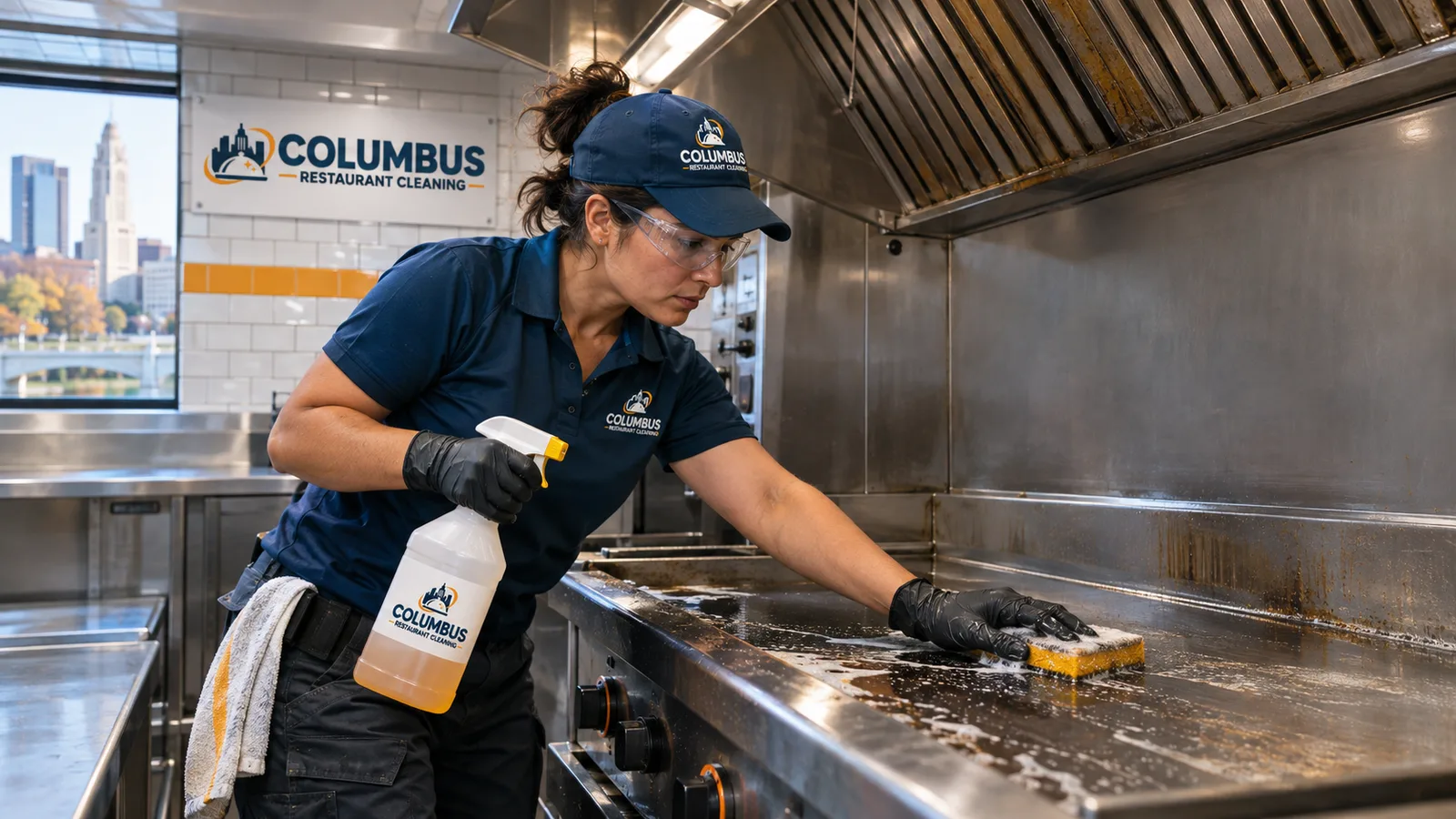
A trained commercial cleaner degreasing stainless steel cooking equipment in an active Columbus restaurant kitchen with food and utensils removed from the work area
Commercial Kitchen Cleaning · Columbus, Ohio

Commercial Kitchen Cleaning Services in Columbus

Detailed cleaning for cooking equipment, prep areas, floors, walls, and exhaust systems, scheduled around your operating hours and documented with a clear scope.

✓Cooking equipment ✓Floors and walls ✓Hoods and exhaust ✓Scheduled service
Site-Specific Scope

Professional Cleaning Built Around Your Kitchen

Commercial Kitchen Cleaning Services address the grease, carbon, food residue, and soil that routine closing work may leave behind. Columbus Restaurant Cleaning develops each scope around the equipment, surfaces, access limits, operating schedule, and condition of the kitchen. The goal is a practical plan that reaches neglected areas without interfering with food production more than necessary.

As an experienced restaurant service team in Columbus, OH, we clean commercial kitchens for independent restaurants, bars, cafeterias, commissaries, and other food-service operations. A busy Short North restaurant may need work scheduled after late service, while a Brewery District kitchen may have compact equipment lines and limited staging room. Operations near Easton often need cleaning coordinated around long service windows. These conditions affect crew access, sequencing, and the time required.

A written scope identifies what will be cleaned, which equipment can be moved, whether exhaust components are included, and what the operator must prepare. This matters because professional kitchen cleaning is not one universal package. A focused equipment-line cleaning differs from a full commercial kitchen deep cleaning that includes walls, floors, drains, shelving, and accessible areas behind appliances.

Check Availability
Cleaning Capabilities

What Our Kitchen Cleaning Services Can Cover

Cooking Equipment

Degreasing and detail cleaning can cover accessible surfaces on ranges, ovens, fryers, griddles, charbroilers, salamanders, and other cooking equipment. Service is planned around manufacturer guidance and the condition of each unit.

Equipment Lines and Work Areas

Crews clean exposed sides, fronts, legs, casters, undersides, and reachable spaces behind equipment when access and utility connections permit. Prep tables, shelving, sinks, and splash areas can be added to the scope.

Floors, Walls, and Drains

Commercial kitchen deep cleaning can include degreasing floors, edges, wall surfaces, base areas, and accessible floor drains. Methods are selected for the surface and soil rather than relying on one chemical for every area.

Hoods and Exhaust Components

Restaurant hood cleaning services can address filters, hood interiors, ducts, and exhaust fans when those components are included in the inspected scope. Exhaust-system work requires different access and documentation than general kitchen cleaning.

Cold-Side and Storage Areas

Walk-in floors, cooler exteriors, racks, shelving, and dry-storage surfaces can be cleaned after food and loose inventory are protected or relocated. Interior refrigeration cleaning requires advance preparation and temperature planning.

Detail and Touchpoint Cleaning

Door handles, control surrounds, ledges, switch plates, kick plates, and other accessible touchpoints can be included. Sensitive controls, labels, pilot assemblies, and electrical components receive methods suited to the equipment.

Check Availability
Exhaust-System Scope

Restaurant Hood Cleaning in Columbus, Ohio

A kitchen exhaust system carries grease-laden vapor through the hood, filters, ductwork, and fan. Cleaning only visible stainless steel does not address deposits deeper in the system. A proper assessment identifies access panels, filter condition, duct configuration, fan access, roof or ladder requirements, and areas that cannot be reached safely.

NFPA 96 is the widely used standard for ventilation control and fire protection in commercial cooking operations. Cleaning frequency is not a single schedule for every restaurant. It depends on cooking volume, fuel type, equipment, and the amount of grease produced. Solid-fuel cooking and high-volume charbroiling can create different service needs than a low-volume electric cooking line.

Our restaurant hood cleaning services in Columbus can be coordinated with broader kitchen cleaning, but the scopes should remain distinct. Hood and duct work may require containment around the cooking line, filter removal, fan access, grease collection, and post-service documentation. General kitchen cleaning focuses on equipment exteriors and surrounding surfaces. The initial review determines which work is appropriate and how it should be sequenced.

Check Availability
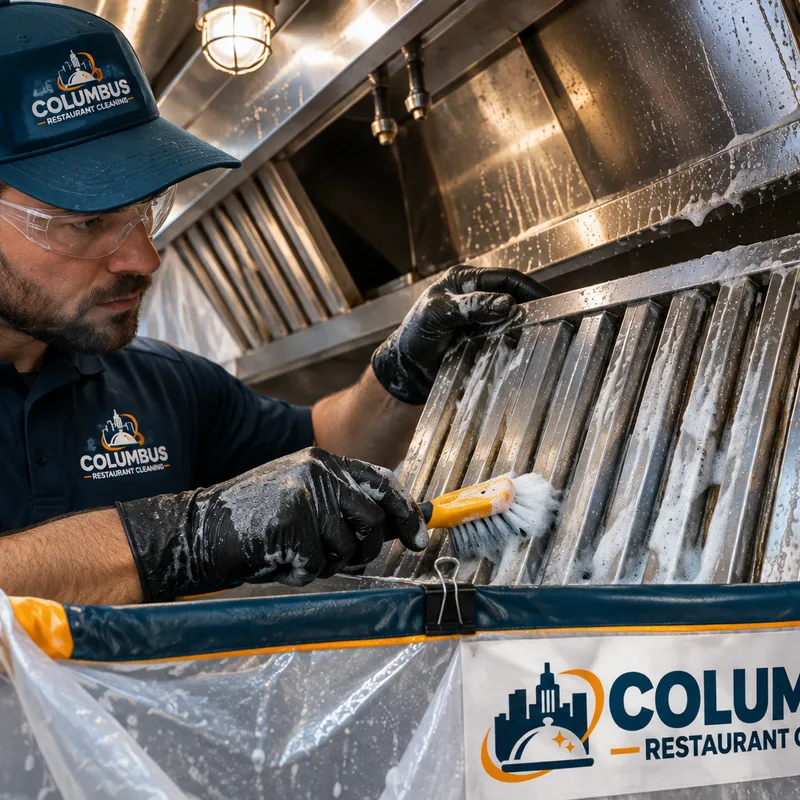
A technician cleaning removable baffle filters and the stainless steel interior of a commercial restaurant hood using protective containment
Exhaust cleaning is scoped according to system access, cooking volume, and grease accumulation.
From Review to Completion

How Commercial Kitchen Cleaning Works

  1. 01

    Review the Kitchen and Priorities

    We discuss the type of operation, service hours, cooking methods, equipment, problem areas, and any deadline tied to reopening, maintenance, or an inspection. Photos may help with initial planning, but complex kitchens often benefit from an on-site review.

  2. 02

    Define the Cleaning Scope

    The work plan lists included equipment and surfaces, access requirements, exclusions, and preparation duties. We also identify whether water, power, gas, ventilation, roof access, or an authorized site contact will be needed.

  3. 03

    Prepare and Protect the Work Area

    Food, utensils, packaging, and loose supplies must be removed or protected. The crew establishes containment where needed and confirms which appliances may be shut down or moved. Utility disconnection is handled only when authorized and appropriate.

  4. 04

    Degrease, Agitate, and Rinse

    Technicians apply products suited to the soil and surface, allow controlled dwell time, agitate deposits, and remove residue. Scrapers, pads, brushes, low-pressure application, wet extraction, or steam may be used where appropriate.

  5. 05

    Inspect the Completed Work

    The crew reviews included areas, notes access limitations or maintenance concerns, and returns equipment to the agreed position when permitted. The operator receives any completion records included in the scope.

Check Availability
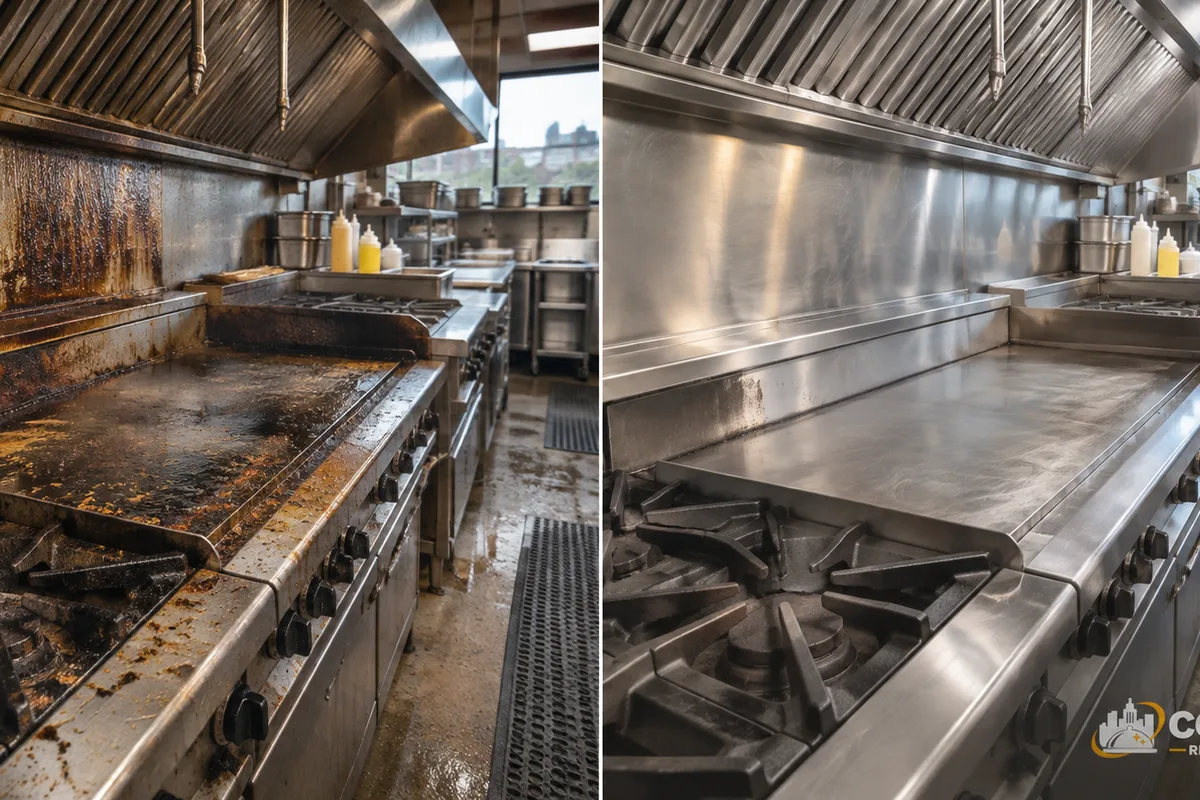
A realistic side-by-side view of a grease-coated commercial range line before service and the same accessible stainless steel surfaces after detailed degreasing
Results depend on soil age, surface condition, safe access, and the limits established before work begins.
Surface-Specific Methods

Kitchen Equipment Cleaning Requires the Right Method

Grease removal is not a matter of applying the strongest available chemical. Stainless steel, aluminum, painted panels, rubber seals, ceramic surfaces, and electrical controls react differently to heat, moisture, alkalinity, and abrasion. A professional kitchen cleaning crew selects tools and chemistry according to the equipment and tests uncertain surfaces before wider use.

Heavy carbon on a griddle or oven may require repeated applications and careful scraping. Fryer exteriors often collect polymerized grease around edges and casters. Range lines can hide residue along side panels, gas manifolds, and wall junctions, but technicians must avoid saturating burners, ignition components, motors, and controls. Oven interiors also require methods compatible with the manufacturer's instructions.

Some tasks need coordination with qualified equipment, electrical, plumbing, or gas technicians. Cleaners should not disconnect fixed utilities, open protected electrical assemblies, or dismantle equipment beyond the agreed scope. If equipment cannot be moved safely, the limitation should be documented rather than concealed.

Check Availability
Operational Fit

Scheduling Restaurant Kitchen Cleaning in Columbus

Commercial kitchens rarely have unlimited downtime. Cleaning may need to begin after closing, before prep starts, during a planned dark day, or as part of a shutdown. The right schedule depends on the work. A focused floor and equipment-line service may fit within one access window, while a heavily soiled kitchen or exhaust system may require more time.

Columbus operating conditions also affect planning. Restaurants in the Short North and Downtown may have restricted loading, shared alleys, paid parking, or late closing hours. Brewery District properties can include older commercial spaces where equipment access and utility layouts differ by building. Suburban operations around Easton may have easier loading access but longer daily service windows. These practical details determine crew arrival, equipment staging, and whether waste or hoses can move through customer areas.

Cold Ohio weather matters when roof access is required for an exhaust fan. Ice, snow, high wind, and unsafe roof conditions can delay that part of the job even when interior kitchen cleaning can proceed. A site contact should also confirm alarm procedures, keys, loading access, and approved shutdown times before an overnight appointment.

Check Availability
Compare the Scope

Choosing a Commercial Kitchen Cleaning Company

Compare companies by the clarity of their scope, not by a single price. A useful proposal identifies the equipment and surfaces included, access assumptions, preparation requirements, expected service window, and exclusions. Terms such as “deep clean” can mean very different things unless the actual tasks are written down.

Ask how the crew protects food-contact areas, controls wastewater and overspray, handles sensitive equipment, and reports areas that were inaccessible. For restaurant hood cleaning in Columbus, ask whether the proposed work includes filters, plenum, ductwork, fan components, containment, and documentation. Visible hood polishing alone is not equivalent to exhaust-system cleaning.

Columbus Restaurant Cleaning starts with the operating needs of the facility and the actual condition of the kitchen. Photos, equipment details, cooking methods, and access information help establish an initial plan. A walkthrough may be recommended when the kitchen is large, the buildup is extensive, equipment must be moved, or roof access is involved.

Check Availability

A clear scope makes it easier to compare proposals, plan downtime, and prepare the kitchen before the crew arrives. Tell us what needs attention and when the space is available.

Call to Schedule
Practical Answers

Commercial Kitchen Cleaning Questions

How much do commercial kitchen cleaning services cost in Columbus?+

Pricing depends on kitchen size, soil level, equipment count, access, and whether exhaust-system cleaning is included. A compact equipment line with moderate grease requires less labor than a full kitchen with heavy carbon, walls, floors, drains, coolers, and hard-to-reach areas. Hood pricing also changes with duct length, fan access, access-panel availability, and roof conditions. Columbus Restaurant Cleaning confirms the exact price after reviewing the requested scope and site conditions.

How long does restaurant kitchen cleaning take?+

A focused cleaning may fit within one after-hours window, while a full commercial kitchen deep cleaning can require a longer shutdown or phased work. Heavy buildup, tightly packed equipment, utility restrictions, and exhaust access add time. For Downtown or Short North locations, loading and parking arrangements should be settled before arrival so the scheduled work window can be used efficiently.

How often should a restaurant hood be cleaned?+

Hood cleaning frequency should be based on the cooking operation, grease production, system condition, and applicable fire-safety requirements. High-volume cooking, charbroiling, wok cooking, and solid-fuel appliances can require more frequent attention than low-volume operations. NFPA 96 provides inspection-frequency guidance by cooking type, while the authority having jurisdiction and the facility's insurer may impose additional requirements.

Can kitchen cleaning be completed overnight?+

Yes, overnight cleaning is often possible when access, shutdown, alarm, and reopening requirements are arranged in advance. The restaurant must allow enough time for cleaning, drying, inspection, and safe startup before prep begins. If roof access is part of restaurant hood cleaning services in Columbus, winter weather or unsafe roof conditions may require that portion to be rescheduled.

What must the restaurant do before the cleaners arrive?+

The restaurant usually needs to remove or protect food, utensils, packaging, linens, and loose inventory in the work area. Staff should identify equipment that may be powered down, confirm access points, and provide instructions for alarms or locked areas. Refrigerated inventory needs a separate plan if cooler interiors are included. Exact preparation duties are listed in the agreed scope.

Do restaurant kitchen cleaners move cooking equipment?+

Equipment may be moved only when it is safe, authorized, and compatible with utility connections and floor conditions. Mobile units on sound casters are different from appliances with fixed gas, electric, water, or exhaust connections. A cleaner should not force movement or disconnect utilities outside the approved scope. Inaccessible areas are documented so the operator can arrange qualified trade support when needed.

Can you clean while the kitchen remains open?+

Limited work may be possible away from active food preparation, but deep cleaning usually requires the affected area and equipment to be out of service. Degreasers, moisture, tools, hoses, and floor work can conflict with food handling and employee traffic. For busy Easton-area operations with long service windows, phased cleaning or an approved closed period may be the safer plan.

Is commercial kitchen cleaning the same as sanitizing food-contact surfaces?+

No, cleaning removes grease, soil, and food residue, while sanitizing is a separate step performed on a properly cleaned food-contact surface with an appropriate product and procedure. The written scope should state whether food-contact sanitizing is included. Restaurant staff must still follow their food-safety plan and product-label requirements before resuming preparation.

Define the Work

Plan a Cleaner Commercial Kitchen

Describe the kitchen, equipment, problem areas, and preferred service window. Columbus Restaurant Cleaning will help define the work, preparation needs, and realistic schedule before cleaning begins.

Contact Us

Request Your Cleaning Quote

Tell us about your restaurant and cleaning needs. We’ll follow up to discuss the right scope for your space.